



Have you ever wondered whether there’s a path between soul-crushing corporate life and high-risk startup gambling? Well, there is. It’s called a lifestyle business – and once you understand what it really means, you might never look at your career the same way again.
Imagine this. You got good grades. Attended a prestigious university. Landed yourself a respectable job. On paper, you’re crushing it. So why does Sunday night fill you with dread?
Many professionals in this exact situation feel trapped, wondering if there is something better. A lifestyle business offers exactly that – a business designed to support your ideal life rather than demanding you sacrifice everything for growth or shareholder value.
This guide explains what a lifestyle business actually is, how it differs from startups and freelancing, and why millions of people are quietly building them instead of climbing the traditional ladder.
What Is a Lifestyle Business? (The Real Definition)
A lifestyle business is a business designed to support your ideal lifestyle – not growth at all costs.
That’s the core idea. But this simple definition hides something profound.
Most businesses are designed around the business itself. How do we grow faster? How do we maximize shareholder value? And how do we position for an exit?
A lifestyle business flips this entirely. It asks: What do I actually want my life to look like? Then it designs the business to serve that vision.
This philosophy aligns with what Paul Jarvis (co-founder of Fathom Analytics) calls a “company of one” in his book of the same name – a business that questions growth as the default and instead asks what “enough” looks like for you.
You might also hear these called freedom businesses, freedom-first businesses, or location-independent businesses. The digital nomad community often uses the term interchangeably with their travel-oriented work setups. The label matters less than the principle: designing work around life, not the reverse.
Key Characteristics of a Lifestyle Business
A lifestyle business is typically:
- Self-funded – No investors to answer to
- Owner-operated – You control the decisions that matter
- Freedom-focused – Designed around personal freedom, not growth metrics
- Profitable from early on – Usually 6-7 figures ($100K to $1M+ in revenue)
The crucial difference? A lifestyle business gives you freedom during the journey, not just at the destination.
The traditional path says: sacrifice now, grind for decades, maybe be free someday. The lifestyle business path says: why wait? Design something that gives you meaningful freedom while you’re building it.
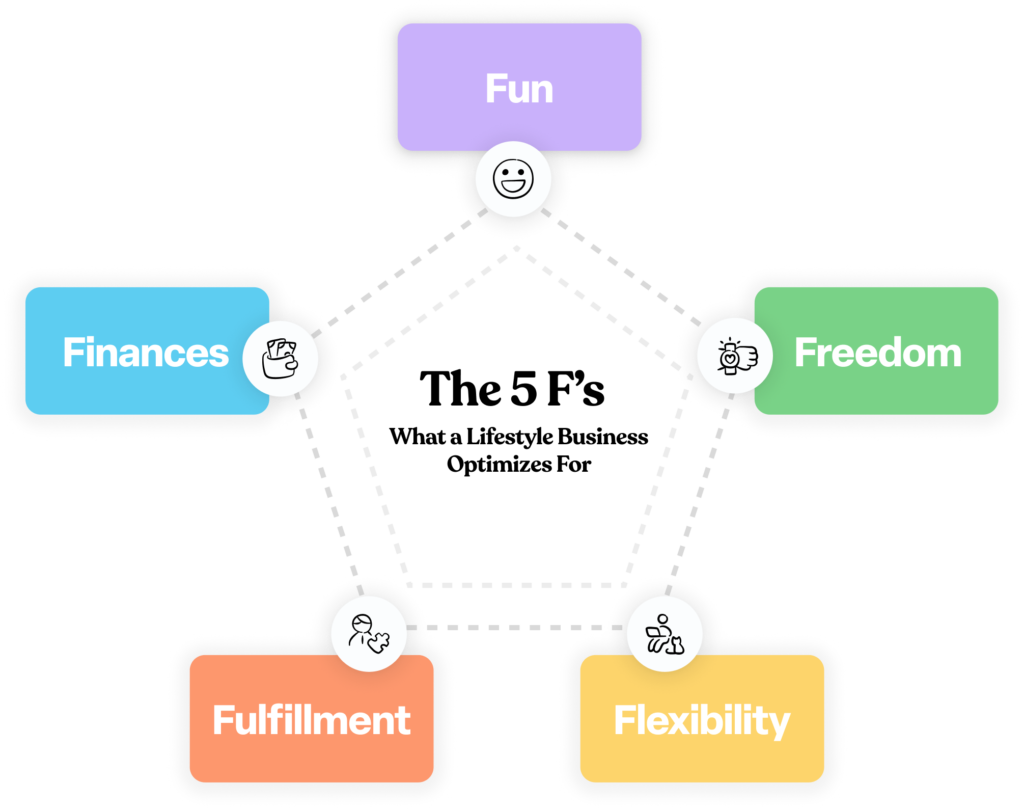
The 5 F’s: What a Lifestyle Business Optimizes For
If startups optimize for growth and exits, what does a lifestyle business optimize for?
The answer is the 5 F’s framework:
1. Fun
Work you actually enjoy. Work that energizes rather than drains you.
You’ll spend roughly 80,000 hours of your adult life working. A lifestyle business is built around work that feels a little bit like play.
2. Freedom
Control over your time and decisions.
Freedom means you’re not at the mercy of a boss’s mood, a company’s restructuring, or an industry’s whims. Your financial future is in your own hands.
3. Flexibility
Work when you want, where you want.
Want to start at 10am? Fine. Take Wednesdays off for your kids? Go ahead. Work from Lisbon for a month? Pack your bags.
4. Fulfillment
Meaningful work aligned with your values.
Fulfillment comes from growth and contribution. A lifestyle business provides both – you’re constantly learning while directly helping customers solve real problems.
5. Finances
Enough money to live well – though not necessarily maximum money.
A lifestyle business isn’t about making as much as physically possible. It’s about making enough to fund the life you actually want.
The key insight: Traditional careers force trade-offs. Want money? Sacrifice time. Want flexibility? Accept less status.
A lifestyle business attempts to optimize for all five simultaneously – not maximizing any single F, but finding a balance that creates a genuinely good life.
What a Lifestyle Business Is NOT
Let’s be specific about what a lifestyle business isn’t. These distinctions matter.
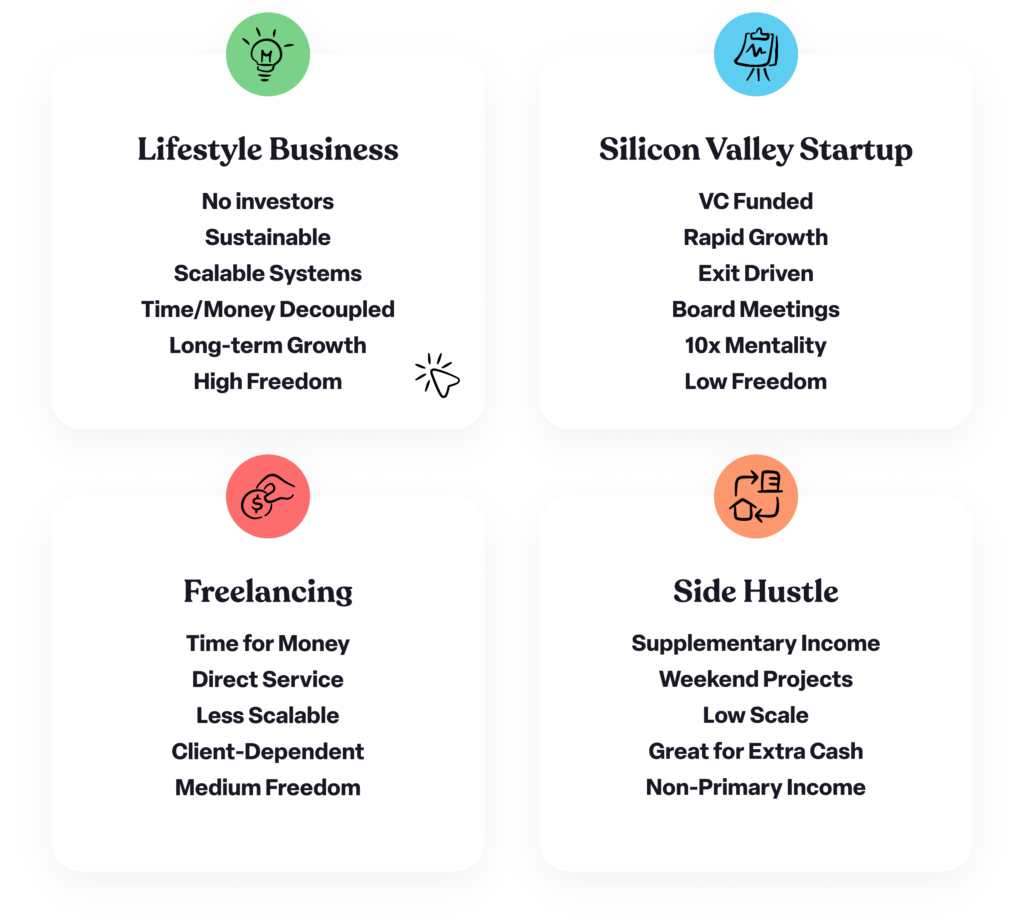
Not a Silicon Valley Startup
Startups optimize for rapid growth, often with venture capital, aiming for massive exits.
A lifestyle business has no investors. No board meetings. No pressure to 10x next quarter. You’re accountable to yourself and your customers – that’s it.
Not a Side Hustle
“Side hustle” implies supplementary income – a few hundred dollars from weekend projects.
A lifestyle business is a real, sustainable business. It can become your primary income, supporting you and your family for decades.
Not a Get-Rich-Quick Scheme
Building a lifestyle business takes real work, time, and patience.
The realistic timeline? Most people reach $100,000 per year within 12-18 months of focused effort. Getting to $1 million typically takes 3-5 years. Achievable – but not overnight.
Not Freelancing
Freelancing trades time for money directly. Stop working, income stops.
A lifestyle business is more scalable. The goal is to eventually decouple income from time – through systems, products, or team members.
Not “Passive Income” from Day One
The beach-and-laptop fantasy is misleading. Passive income is real – but it comes after you’ve done the active work to build something valuable.
The “passive” comes after the “active” – not instead of it.
Why “Lifestyle Business” Is Sometimes Used as an Insult
Here’s something interesting: in certain circles, “lifestyle business” is actually a pejorative.
In Silicon Valley and VC circles, you might hear:
“Oh, that’s just a lifestyle business.”
The implication? It’s somehow less ambitious than a “real” startup.
Why This Criticism Misses the Point
The venture capital model needs billion-dollar exits to work. So VCs naturally look down on businesses “only” making a few million dollars with healthy margins and happy founders.
But here’s what they miss: most people don’t want billion-dollar exits.
Most people want a good life. Time with family. Meaningful work. Financial security without financial obsession. To be done thinking about work when not working.
The Reframe
A lifestyle business isn’t less ambitious. It’s ambitious about different things.
- A startup founder is ambitious about scale, market dominance, financial returns
- A lifestyle business owner is ambitious about life itself – freedom, joy, meaning, adventure
Here’s the irony: many startup founders, after their big exit, try to build… a lifestyle business. They’ve achieved financial freedom and now want the life that comes with it.
Why wait until you’re 45 and burnt out?
The Freedom Profile: Rating Your Current Situation
Here’s a useful thought experiment.
Imagine you won the lottery tomorrow – enough that you never need to worry about money again.
What would you do?
After some travel and relaxation, you’d get bored. Humans need purpose. So you’d want to do some work – but not because you have to. Because you want to.
What would that work look like?
Probably:
- Something fun and engaging
- Something that gives fulfillment and meaning
- Something with flexibility – work when and where you want
In other words: you’d design a lifestyle business.
Rate Your Current Career
You can rate any income source on these dimensions:
| Dimension | Your Score (1-10) |
|---|---|
| Fun | ? |
| Freedom | ? |
| Flexibility | ? |
| Fulfillment | ? |
| Finances | ? |
A stressed corporate lawyer might score:
- Fun: 3 | Freedom: 2 | Flexibility: 2 | Fulfillment: 4 | Finances: 8
A successful lifestyle business owner might score:
- Fun: 8 | Freedom: 9 | Flexibility: 9 | Fulfillment: 8 | Finances: 7
The point isn’t perfection across all dimensions. It’s consciously designing for the balance you want.
The Math That Makes Lifestyle Businesses Work
One of the biggest misconceptions about making money is that you need to serve huge numbers of people.
This is wrong. Understanding why changes everything.
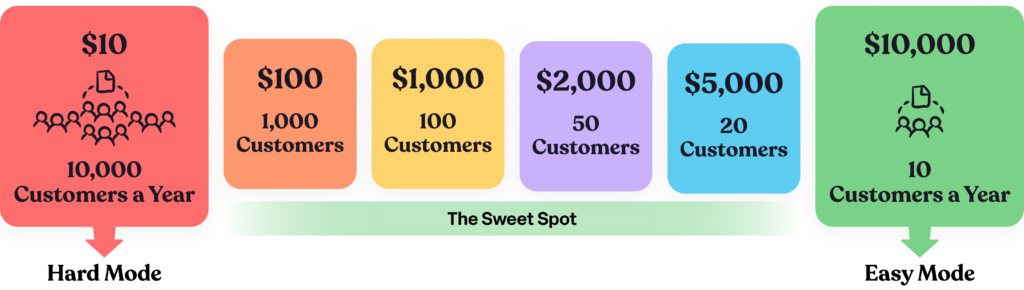
How to Make $100K Per Year
Here are some options:
| Price | Customers Needed Per Year |
|---|---|
| $10 | 10,000 |
| $100 | 1,000 |
| $1,000 | 100 |
| $2,000 | 50 |
| $5,000 | 20 |
| $10,000 | 10 |
All paths reach $100,000. But they are NOT equally difficult.
Why Premium Pricing Is Easier
Your intuition might say selling cheap is easier. After all, anyone would pay $10!
This intuition is backwards.
The hard part of business is finding customers – .
Finding 10,000 customers for a $10 product requires massive marketing reach, significant ad spend, and usually some existing fame.
Finding 10 customers for a $10,000 service requires personal relationships, direct outreach, and high-quality delivery.
The second scenario is dramatically more achievable starting from scratch.
The $2K-$20K Sweet Spot
For most lifestyle businesses, the sweet spot is $2,000 to $20,000 per product or service:
- $2K per sale = 50 customers/year (about 1 per week)
- $5K per sale = 20 customers/year
- $10K per sale = 10 customers/year
These are manageable numbers. No fame required. No massive audience needed. Just genuine expertise and the ability to find a small number of people who value it.
This math is precisely why lifestyle businesses are so viable.
Lifestyle Business Examples (Online and Offline)
Theory is nice – but what does a lifestyle business look like in practice?
Online Lifestyle Business Examples
The Coach or Consultant
Sarah left her corporate HR job to become a leadership coach. She works with 25 clients per year at $6,000 each (3-month programs). That’s $150,000 in revenue.
She works 20-25 hours per week, takes 6 weeks off per year, and her commute is bedroom to home office.
The Online Educator
James spent 15 years as a financial analyst. Now he teaches personal financial modeling through a $3,000 course run quarterly. With 40 students per year, he makes $120,000.
He works about 15 hours per week during courses, less between them.
The Boutique Agency Owner
Maria runs a content marketing agency with two contractors. They work with 8 clients at $4,000/month. That’s $384,000 annually, with about $180,000 profit after team costs.
She works 30 hours per week and spends a month each year in Portugal.
Offline Lifestyle Business Examples
The Specialty Photographer
David shoots brand photography exclusively for small businesses. He does 40 shoots per year at $3,500 each, making $140,000.
He’s structured his schedule as one week on, one week off – pursuing his own creative projects half the time.
The Local Bookshop Owner
Jane runs a bookshop in a small town, designed around her life. Opening hours match her family commitments. She closes every other Wednesday to go hiking. She hosts book clubs she genuinely enjoys.
Not millions – but enough. And a life she actually wants.
The Premium Craftsperson
Tom creates custom furniture for 12-15 clients per year at $8,000-$15,000 per piece. He makes around $150,000 annually with a 6-month waitlist, only taking commissions he’s excited about.
The Common Thread
What do these examples share?
- They solve real problems for specific people
- They charge premium prices rather than competing on volume
- They’re built around the owner’s desired lifestyle
- They generate solid income without 60-hour weeks
- They provide autonomy over time, location, and clients
Realistic Timelines for Building a Lifestyle Business
Most content about lifestyle businesses either overpromises or is too vague. Here’s what realistic success looks like.
Timeline to $100K/Year
For most people starting from scratch with a professional background:
- With 10-15 hours per week: 12-18 months to reach $100K run rate
- With 20-30 hours per week: 6-12 months to reach $100K run rate
These timelines assume you’re following a proven approach and selling at premium price points ($2K-$20K).
Timeline to $1M/Year
Getting from $100K to $1M typically takes 3-5 years.
This requires developing sophisticated skills, building systems, and often adding team members. A million-dollar lifestyle business at 50% margins means $400,000-$500,000 in profit – more than enough financial freedom for almost anyone.
The Upper Ceiling
Here’s something most content won’t tell you: it’s genuinely difficult to scale beyond $10 million while maintaining the “lifestyle” part.
The good news? Very few people actually want a $10 million business. The satisfaction available in the $200K-$2M range exceeds almost anyone’s actual goals.
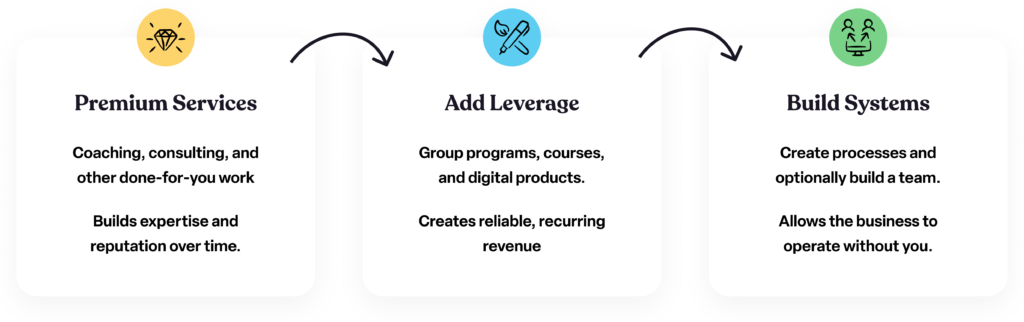
The Typical Path
- Start with premium services ($2K-$20K per client)
- Coaching, consulting, done-for-you work
- Builds expertise and reputation
- Add leverage over time
- Group programs
- Courses and digital products
- Recurring revenue offers
- Build systems and (optionally) a team
- Processes that don’t require constant involvement
- People who can deliver without you
The mistake is trying to skip to step 3 immediately – wanting passive income without active work first.
The Honest Challenges of a Lifestyle Business
No path is without trade-offs. Here are the real challenges – and how people navigate them.
No Guaranteed Paycheck
Unlike a salary, your income will fluctuate. Some months will be great; others will be slower. This uncertainty is real, especially in the early stages.
How people handle it: Build recurring revenue where possible, maintain an emergency fund (6+ months of expenses), and consider starting your lifestyle business as a side project while employed. The goal is removing financial desperation from your decision-making.
You Wear Every Hat (At First)
Marketing, sales, delivery, customer service, bookkeeping, tech support – especially early on, it’s all you. This can feel overwhelming if you’re used to specialised roles.
How people handle it: Identify your highest-value activities and outsource the rest as soon as financially viable. Virtual assistants, bookkeepers, and freelancers can handle tasks that drain your time. Automation tools can eliminate repetitive work entirely.
Intentionally Limited Scale
A lifestyle business, by design, has a ceiling. If you optimise for freedom over growth, you’re choosing not to build an empire. For some, this feels like leaving potential on the table.
How people handle it: Reframe this as a feature, not a limitation. Define your “enough” number – the income that funds your ideal life – and design around it. Most people discover that “enough” is far less than they assumed.
Isolation and Loneliness
Working independently can be lonely, especially if you’re naturally social. Theres no colleagues, no office banter, and no team to celebrate wins with.
How people handle it: Join communities of other lifestyle business owners (they exist everywhere – online and in-person). Find accountability partners. Use co-working spaces occasionally. Build connection into your business through client relationships and industry networks.
Self-Discipline Without External Structure
No boss means no one telling you what to do. That sounds great until you realise no one is holding you accountable either. Without external structure, it’s easy to drift.
How people handle it: Create your own structure, and build systems. Establish routines, set deadlines (and honour them), join accountability groups, or hire a coach or mentor. The freedom requires discipline – but it’s discipline in service of your own goals.
The Freedom Takes Time to Build
The flexibility and freedom that makes lifestyle businesses attractive? It comes after you’ve built the foundation. The first year or two often involves significant work to get the flywheel spinning.
How people handle it: Set realistic expectations. Celebrate milestones along the way. Remember that even during the building phase, you have more autonomy than most employees. The early work compounds – it doesn’t last forever.
Why Smart Professionals Often Struggle with Entrepreneurship
Here’s something that might resonate if you have a traditional educational background:
School trained you for the opposite of entrepreneurship.
School vs Business: The Mismatch
| School Taught You | Business Requires |
|---|---|
| Find the right answer | Experiment to discover answers |
| Wait until you’re ready | Start before you feel ready |
| Ask permission | Take initiative without permission |
| One submission, one grade | Continuous iteration and improvement |
| Blend in | Stand out |
| Avoid failure | Learn from failure |
If you’ve spent 15-20 years in educational and corporate environments, you’ve been trained to think in ways that are actively unhelpful for building a business.
This explains imposter syndrome, perfectionism, and the constant sense of “not being ready yet.”
It’s not because something’s wrong with you. It’s because you’re running old software designed for a different operating system.
The good news: you can learn new patterns.
Is a Lifestyle Business Right for You?
Not everyone should build a lifestyle business. Let’s be honest about who this path suits.
A Lifestyle Business Might Be Right for You If:
- You value autonomy over status – $150K on your terms beats $300K answering to others
- You have skills people will pay for – expertise others want to learn or have done
- You’re willing to be uncomfortable – marketing yourself and facing rejection
- You can delay gratification – building takes months to years
- You’re okay with “enough” rather than “more” – accepting constraints for freedom
- You need flexibility for health or caregiving – chronic conditions, mental health needs, or family responsibilities that don’t fit a 9-5 structure
A Lifestyle Business Might NOT Be Right for You If:
- You want certainty – no guaranteed paycheck here
- You hate selling – every business requires some marketing and sales
- You need external structure – some people thrive with bosses and deadlines
- You’re chasing someone else’s dream – you’ll quit when it gets hard
- You’re deeply risk-averse – uncertainty can’t be eliminated entirely
The Honest Question
Ask yourself: If you were already financially free, would you still want to do meaningful work on your own terms?
If yes, a lifestyle business is worth exploring.
Frequently Asked Questions About Lifestyle Businesses
How much money can you make with a lifestyle business?
Most lifestyle businesses range from $100,000 to $1 million or more in annual revenue. With typical profit margins of 40-60%, that translates to $40,000-$600,000+ in take-home income. The ceiling depends on your model, but $10 million is generally where “lifestyle” becomes difficult to maintain.
What’s the difference between a lifestyle business and a startup?
A startup optimizes for rapid growth, often with investor funding, aiming for a large exit (acquisition or IPO). A lifestyle business optimizes for owner freedom and sustainable profit, is self-funded, and has no exit requirement. Startups trade freedom for potential scale; lifestyle businesses trade maximum scale for freedom.
Can a lifestyle business become passive income?
Yes, but not immediately. Passive or semi-passive income comes after building systems, products, or teams that don’t require your daily involvement. Most lifestyle businesses start with active, high-touch work, then gradually add leverage. Expect 2-5 years before meaningful passivity.
Do you need special skills to start a lifestyle business?
You need expertise that others will pay for – but this doesn’t mean formal credentials. Professional experience, learned skills, or even passionate hobbies can become the foundation. Most successful lifestyle business owners package knowledge they already have from careers or life experience.
How is a lifestyle business different from freelancing?
Freelancing directly trades time for money – stop working, income stops. A lifestyle business aims to decouple income from time through systems, products, leverage, or team members. Many lifestyle businesses start as freelancing and evolve into something more scalable.
What are the most common lifestyle business models?
The most common models include: consulting and coaching (premium 1:1 services), online courses and education, boutique agencies (small teams serving select clients), productized services, and content-based businesses with digital products. Most successful lifestyle businesses start with high-ticket services before adding scalable offers.
The Real Opportunity
We’re living through an unprecedented moment. The tools to build a lifestyle business – laptop, internet, video calls, payment processing – are more accessible than ever.
Twenty years ago, starting a consulting practice meant offices, receptionists, and local-only clients. Now you can reach anyone from your spare bedroom.
The barriers that used to exist – geographic, financial, technological – have collapsed.
What remains is what’s always separated people who build the life they want from those who don’t: the willingness to actually do it.
What Comes Next
If you’ve read this far, you likely fall into one of three camps:
Camp 1: “This sounds amazing, but I have no idea how to actually do it.”
That’s normal. Understanding what a lifestyle business is differs from knowing how to build one. The good news: proven methods exist. You don’t need to figure it out alone.
Camp 2: “I’m intrigued but skeptical.”
Valid. The lifestyle business world has charlatans. But notice: the examples here aren’t lottery winners. They’re people with expertise who learned to package and sell it. If you have professional skills and willingness to learn, the same is possible for you.
Camp 3: “I knew this was possible – I just needed someone to articulate it.”
Sometimes we know something intuitively but need words for it. Now you can think about it more clearly.
The Question Worth Sitting With
The word “lifestyle” in lifestyle business isn’t about beaches and martinis.
It’s about designing work around your life, rather than the reverse. Andrecognizing that “success” means nothing if you’re miserable getting there.
It’s about being ambitious about the right things: freedom, fulfillment, fun, flexibility, and finances that serve your actual life.
Traditional advice says: defer, sacrifice, wait. Work hard now, enjoy later.
The lifestyle business philosophy offers a different question:
What if you could have meaningful freedom while building something valuable?
What if the journey itself could be enjoyable?
And what if you didn’t have to wait?